
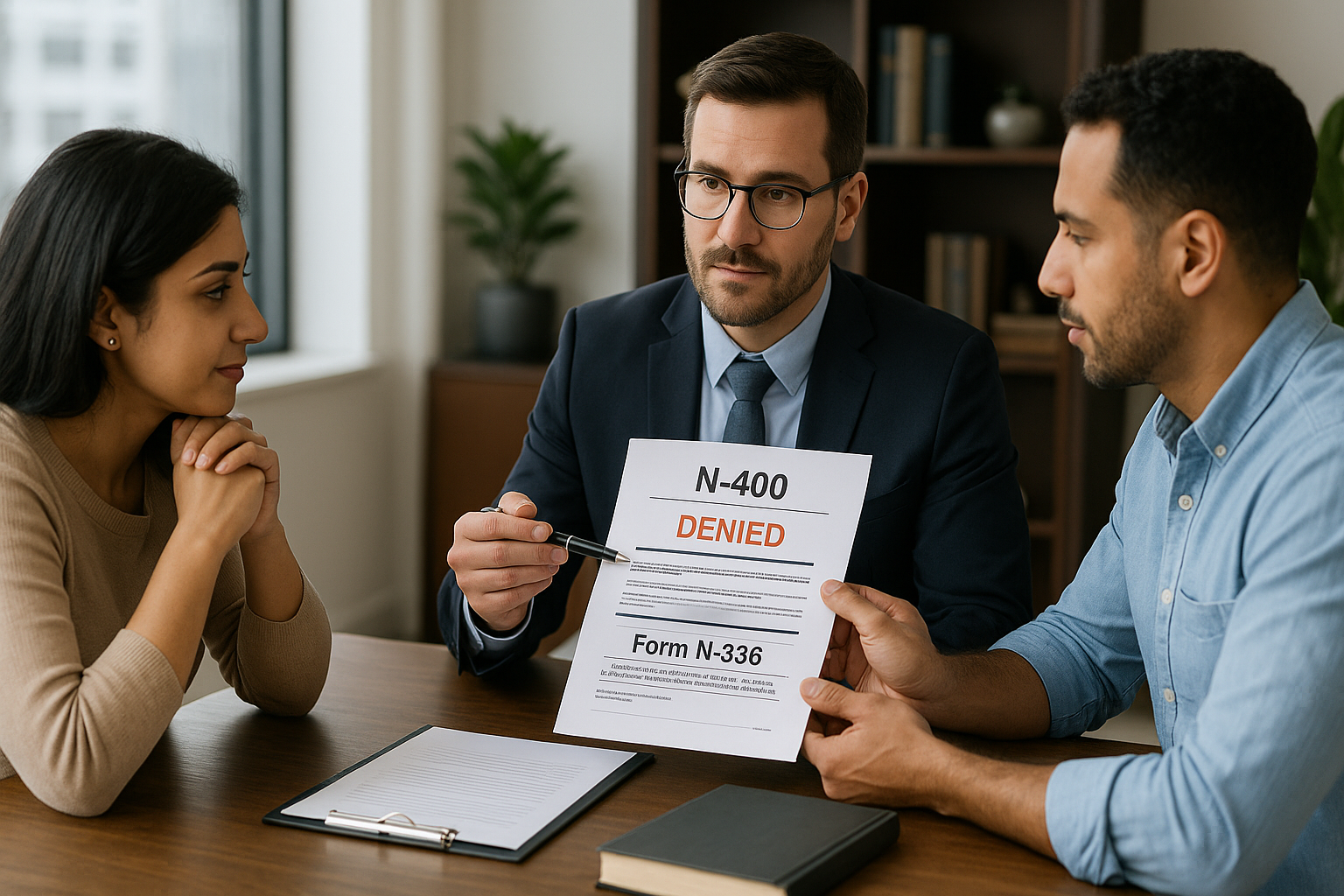
Getting your N-400 denied can feel like a devastating setback after months of preparation, gathered documents, and the interview you waited so long for. But a denial is not the end of your path to citizenship. You have real options, and the right move depends on why USCIS turned down your application.
At Vega & Associates, our Houston immigration team has guided clients through the naturalization process for more than 45 years. According to USCIS naturalization data, denial rates vary by year and applicant background, so understanding your specific denial reason is the first step. You may be able to request a hearing using Form N-336 within 30 days, or in some situations simply refile. Our naturalization and citizenship services cover both paths. This guide walks you through every option so you can move forward with confidence.
1. Why USCIS Denies an N-400 Application
2. Form N-336: Your Right to a Hearing
3. How to File Form N-336 After a Denial
4. When Refiling Makes More Sense Than N-336
5. Common Denial Reasons and How to Fix Them
Why USCIS Issues an N-400 Denied Decision
A denial notice arrives by mail. It lists the specific reason USCIS rejected your naturalization application. Reading that reason carefully is not optional. It is the most important thing you can do right now.
USCIS denies N-400 applications for many reasons. Some are legal bars. Others are fixable mistakes. Knowing the difference saves you time and money. So before you do anything else, read your notice word for word.
Legal Bars That Cause an N-400 Denial
Some denials come from legal bars. These are hard stops in the law. Common legal bars include a criminal record, failure to meet continuous residence, or not meeting the physical presence requirement.
For example, certain crimes make you permanently ineligible. Others create a temporary bar. If your notice cites a criminal matter, you need an attorney immediately. The stakes are high. A wrong move can trigger removal proceedings.
Also, trips outside the U.S. over six months can break continuous residence. USCIS counts your time carefully. If your N-400 was turned down for this reason, you may need to wait and reestablish your residence clock before refiling.
Fixable Errors Behind an N-400 Denial
Not every denial involves a legal bar. Many happen because of missing documents, wrong answers on the form, or a failed English or civics test. These are fixable.
If you failed the English test, you can retake it. USCIS gives you a second chance at the interview. But if USCIS already denied your application after two failed attempts, you need to refile. The same applies to civics test failures.
Missing documents are another common cause. USCIS may have sent a Request for Evidence (RFE) that you did not answer fully. If your N-400 denied notice points to missing paperwork, refiling with complete documents is often the fastest fix.
Your notice tells you exactly why USCIS said no, so read it carefully before choosing your next step. Legal bars require an attorney’s review. Fixable errors, like missing documents or a failed test, often let you refile quickly without a formal hearing.
Form N-336: Your Right to a Hearing After a Denial
When your N-400 is denied, federal law gives you the right to appeal. You do this with Form N-336, the Request for a Hearing on a Decision in Naturalization Proceedings. This is your formal appeal. It goes to a USCIS officer who was not involved in the original decision.
The N-336 hearing is not a court case. It is an administrative review. A different USCIS officer looks at your case fresh. You can submit new evidence. You can bring an attorney. And you can make arguments that were not heard the first time.
This process exists because USCIS makes mistakes. Officers misread documents. They apply the wrong legal standard. The N-336 gives you a real chance to correct those errors.
The 30-Day Deadline for N-336
You have exactly 30 days to file Form N-336 after your N-400 denied decision. Miss that window and you lose your right to a hearing. USCIS counts from the date on your notice, not the date you received it.
So act fast. Do not wait to see if the situation resolves itself. It will not. Pull out your notice right now and check the date. Then count 30 days forward. That is your deadline.
If you are close to the deadline, call an immigration attorney today. Vega & Associates handles N-336 filings for Houston clients. We can review your case and prepare your hearing request quickly.
What Happens at the N-336 Hearing
The N-336 hearing is a face-to-face meeting with a USCIS officer. You present your case. You can bring documents, witnesses, and legal arguments. Your attorney speaks on your behalf.
The officer reviews your entire file from scratch. They are not bound by the first officer’s decision. So new evidence matters. A strong legal argument matters. This is not a rubber stamp.
After the hearing, USCIS issues a written decision. If they approve your naturalization, you move forward to the oath ceremony. If they deny again, you can appeal to federal district court. That is a longer and more complex process, but it is available.
How to File Form N-336 After a Denial
Filing Form N-336 correctly is critical. A mistake on the form can delay your hearing or get your appeal dismissed. Follow these steps carefully. And consider working with an immigration attorney to make sure everything is right.
The N-336 filing fee is currently $830. You pay this when you submit the form. Fee waivers are available in limited cases. Check the USCIS website for current fee information before you file.
Documents to Include With N-336
Your N-336 package needs more than just the form. Include a copy of your denial notice. Add any new evidence that addresses the reason USCIS gave. Write a clear statement explaining why the decision was wrong.
If your N-400 was denied for a missing document, include that document now. If USCIS misread your travel history, include passport stamps and travel records. If the denial involved a criminal matter, include court records showing the outcome.
Organize your documents clearly. Label each exhibit. USCIS officers review many cases. A well-organized package gets read more carefully. A messy one gets missed details.
Where to Send Your N-336 Form
Mail your N-336 to the USCIS office that issued the decision on your application. The address is on your denial notice. Do not send it to a different USCIS location. It will be rejected or delayed.
Send it by certified mail with return receipt. Keep a copy of everything you send. Track the delivery. USCIS will send you a receipt notice when they receive your N-336. Save that receipt. It proves you filed on time.
After filing, USCIS will schedule your hearing. Wait times vary. In Houston, hearings can take several months to schedule. Use that time to prepare with your attorney.
Always send your N-336 by certified mail with tracking, and keep a copy of every document in your package. Paperwork can get misfiled, and your certified mail receipt is proof you filed within the 30-day window. Without it, you have no way to fight a late-filing claim.
When Refiling N-400 Makes More Sense
Not every denial needs a formal N-336 appeal. Sometimes refiling a new N-400 is faster, cheaper, and smarter. The right choice depends on your specific denial reason and your current situation.
Refiling means starting fresh. You pay the full N-400 filing fee again. But you also get a clean slate. You can correct mistakes, add new documents, and present a stronger case from the start. For some applicants, this is the better path.
Our team at Vega & Associates helps clients decide which route fits their case. We look at the denial reason, your current eligibility, and your timeline. Then we give you a clear recommendation.
Situations Where Refiling N-400 Works Best
Refiling your N-400 makes sense in several situations. First, if you failed the English or civics test twice, you must refile. USCIS will not schedule another test under the same application. You need a new N-400.
Second, if your application was turned down because you did not yet meet the continuous residence or physical presence requirements, wait until you qualify. Then refile. Filing an N-336 appeal will not help if you are legally ineligible right now.
Third, if the denial was based on a simple form error, refiling is often faster than appealing. Correcting the error and submitting a new application can move quicker than waiting for an N-336 hearing date.
Comparing N-336 Appeal vs. Refiling Costs
The N-336 filing fee is $830. The N-400 filing fee is $760 (or $710 if you file online). So the costs are similar. But the time difference can be significant.
An N-336 hearing can take 6 to 12 months to schedule in some USCIS offices. A new N-400 application may process faster if your case is straightforward. So cost alone should not drive your decision.
Also consider attorney fees. A complex N-336 hearing requires more attorney time than a simple refile. Get a clear picture of total costs before you decide. Vega & Associates provides honest assessments so you know exactly what you are facing. You can also review our recent cases to see how we have handled similar situations.
Do not refile your N-400 if the denial was based on a legal bar that has not changed. Refiling with the same facts gets you the same result. If USCIS turned you down for a criminal matter or a legal eligibility issue, fix the underlying problem first. Then refile or appeal.
Common Denial Reasons and How to Fix Them
Understanding the most common reasons USCIS rejects an N-400 helps you build a stronger response. Each reason has a specific fix. Match your situation to the right solution and you save time.
Vega & Associates has seen every type of N-400 denied case over 45 years of immigration practice. The patterns repeat. And the fixes are often straightforward when you know what to look for. Here are the most common reasons and what to do about each one.
Good Moral Character Issues
Good moral character (GMC) is a legal requirement for naturalization. USCIS looks at your conduct during the statutory period, usually the last 5 years (or 3 years for spouses of U.S. citizens). A denial based on GMC is serious.
Common GMC issues include arrests, DUIs, tax problems, failure to pay child support, and lying on immigration forms. Some of these are permanent bars. Others are temporary. An attorney can tell you which category your situation falls into.
If your N-400 was denied for a GMC issue, do not try to fix it alone. The U.S. Department of Justice immigration resources explain the legal standards. But applying them to your specific facts requires legal expertise. Get help before you file anything.
Residence and Physical Presence Failures
Many denials involve residence or physical presence problems. USCIS requires you to have lived in the U.S. for a set period before applying. They also require you to have been physically present for a minimum number of days.
Trips abroad over 6 months can break your continuous residence. Trips over 1 year almost always break it. If your N-400 was denied for this reason, you may need to restart your residence clock. That means waiting and then refiling.
Some applicants qualify for exceptions. Military service members and certain government employees have different rules. If you think an exception applies to you, talk to an attorney. The rules are specific and the documentation requirements are strict. You can also learn more about the difference between green card vs citizenship to understand what each status requires.
If your N-400 was denied, you are not out of options. You have a legal right to appeal with Form N-336 within 30 days. Or you may be able to refile once you fix the underlying issue. The key is acting fast and acting smart. Do not guess at the right path. The wrong choice can cost you months or trigger bigger problems. A consultation with Vega & Associates gives you a clear picture of your options. We have handled N-400 denied cases in Houston for over 45 years. We know what works and what does not.
A denial is serious, but it is not final. You have the right to appeal with Form N-336 within 30 days, or you may be able to refile your N-400 once you address the reason USCIS gave. The right path depends entirely on why your application was turned down.
Vega & Associates has guided Houston immigrants through the naturalization process for more than 45 years, and we can help you weigh whether an appeal or a fresh filing gives you the better shot. You do not have to sort through this on your own. Book a consultation with Vega & Associates to review your situation and get a clear plan. Visit our consultation page to get started today.
Under USCIS naturalization guidance and the governing regulation (8 CFR 336.2), an applicant whose N-400 is denied may request a hearing before an immigration officer by filing Form N-336 within 30 days of receiving the denial. That reviewing officer is different from the one who decided the original case, is not bound by the prior denial, and may consider new evidence you submit, giving you a genuine second look at your eligibility.
The 30-day N-336 clock starts the moment you receive your denial notice, and it does not pause. If a hearing is your path, filing Form N-336 late almost always means losing the right to appeal altogether. Mark the deadline the day your notice arrives and give yourself room to prepare, rather than scrambling at the last minute.
How We Overturned an N-400 Denial in Houston
A recent client came to Vega & Associates after receiving an N-400 denied notice from USCIS. The client had lived in Houston for over 15 years and had a clean record. The decision came as a complete shock.
The Challenge
USCIS denied the N-400 citing a break in continuous residence. The client had taken a 7-month trip abroad to care for a sick parent. USCIS counted that trip as breaking the required continuous residence period. The client had only 18 days left in the 30-day window to file Form N-336.
Our Approach
We reviewed the denial notice and the client’s full travel history the same day they called. Our team identified that the client had maintained U.S. employment and filed taxes during the trip, which supports a continuous residence argument. We prepared and filed Form N-336 within 5 days, well inside the 30-day deadline. We included a detailed legal brief, employment records, tax returns, and a letter from the client’s U.S. employer confirming the temporary nature of the absence.
The Results
The USCIS hearing officer reversed the earlier decision. Our client was approved for naturalization and took the oath of citizenship 4 months after the hearing. The case was resolved without going to federal court. If your N-400 was denied, do not wait. Contact Vega & Associates today to review your options.
Frequently Asked Questions
What should I do immediately after my N-400 is denied?
Read your denial notice right away. Find the exact reason USCIS gave. Then decide fast. You have 30 days to file Form N-336 for a hearing. Contact an immigration attorney immediately. An attorney can review your N-400 denied case and tell you the best next step.
How long do I have to appeal an N-400 denial?
You have 30 days from the date on your denial notice. USCIS counts from the notice date, not the date you received it. File Form N-336 before that deadline. Missing the 30-day window means losing your right to an administrative hearing on your N-400 denied case.
Can I refile my N-400 instead of filing Form N-336?
Yes. Refiling is an option after a denial. It works best when the decision was due to a fixable error, a failed test, or unmet eligibility requirements you can now meet. Refiling means paying the N-400 fee again. An attorney can tell you whether to refile or appeal with N-336.
What is Form N-336 and how does the hearing process work?
Form N-336 is the official appeal form for a rejected naturalization application. It requests a hearing before a different USCIS officer. That officer reviews your case fresh. You can submit new evidence and legal arguments. The N-336 hearing fee is $830 and must be filed within 30 days.
Can a criminal record cause an N-400 denial?
Yes. A criminal record is one of the most common N-400 denied reasons. Some crimes are permanent bars to naturalization. Others create a temporary bar. The type of crime and when it happened both matter. If your N-400 was denied for a criminal matter, consult an immigration attorney before taking any action.
Step-by-Step Process
Step-by-Step: What to Do After a Denial
1. Read your denial notice and find the exact reason USCIS gave
2. Check the decision date and count your 30-day N-336 deadline
3. Contact an immigration attorney to review your denied N-400
4. Decide whether to file Form N-336 or refile a new N-400
5. Gather all documents that address your specific denial reason
6. Complete Form N-336 accurately with attorney help
7. Include a written statement explaining why the decision was wrong
8. Mail your N-336 package by certified mail to the correct USCIS office
9. Save your certified mail receipt as proof of timely filing
10. Prepare for your N-336 hearing with your attorney’s guidance
Quick Reference: What Is N-400 Denied?
An N-400 denied decision means USCIS rejected your application for U.S. naturalization. USCIS sends a written notice. It states the exact reason for the outcome. You have two main options after a denial. First, you can file Form N-336 to request a hearing within 30 days. Second, you can refile a new N-400 application. The right option depends on the reason USCIS gave. Some decisions involve legal bars. Others involve fixable errors. An immigration attorney can review your case and guide your next step.
Additional Resources
• Green Card vs. Citizenship: Key Differences Explained, Understand the legal differences between a green card and U.S. citizenship before you pursue naturalization.
• Immigration Services Overview at Vega & Associates, Explore the full range of immigration services available, including naturalization, appeals, and deportation defense.
• About Our Legal Team, Learn about Vega & Associates’ 45+ years of immigration law experience and board-certified expertise in Houston.
• Recent Immigration Cases, See examples of how our team has resolved complex immigration matters for clients in Houston and across Texas.